Science, clearly told
From a biological idea to a story people can follow.

A lab on one side, its story on the other.
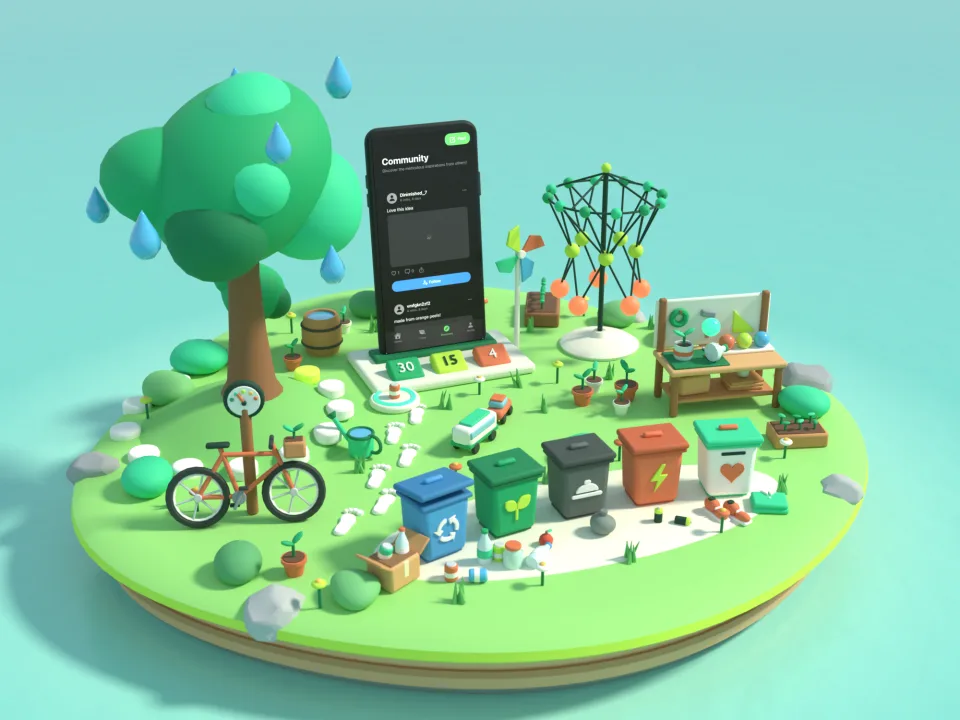
An illustration built for this site in Blender. It explains the idea; it is not data from the project.
A scientific project needs a clear explanation of what it does, how it works, and where it might be useful. LCG-China was a team of high-school students from several countries working on a way to give bacterial cellulose new functions. I led the group that built the team’s wiki, and the entrepreneurship work that asked where the material could go next.
It started with milk tea
The team’s wiki tells the origin plainly: a classmate asked what the coconut jelly in milk tea is made of. The answer is bacterial cellulose, a material grown by microbes that is purer than cellulose from plants, holds water well, is mechanically strong and breaks down naturally. That question became the 2024 project, “Modular Bacterial Cellulose Modification Machine in Use and AI Safety Framework in Synthetic Biology.”
A material that needed help
Plain bacterial cellulose has limits, and proteins are an obvious way to add functions to it. The difficulty is that most useful proteins do not attach to cellulose, so a designer has to trade the property they want against whether it will stick. The team set out to remove that trade-off, building on a system first proposed by Imperial College’s iGEM team in 2014.
Three parts that click together
The design separates the problem into three modules. The first is the cellulose itself. The second is a scaffold: a protein fibre that holds firmly to cellulose and carries a small tag. The third is the protein you actually want, fused to the partner that locks onto that tag. Because the two halves of the lock are standard, a different protein can be swapped in without redesigning the rest, and each module can be improved on its own.
What the team showed
As a proof of concept the team used two colour proteins, one green and one blue, because a successful attachment is then visible to the eye. Pieces of cellulose treated with the scaffold present kept a clearly deeper colour than pieces treated without it. Separately, the team studied how to grow the cellulose more efficiently, comparing nitrogen sources and container shapes; a wider tray turned over 20% of the sugar into cellulose, against about 11.5% for a smaller one.
Giving the research a structure
The team page lists my role as student leader of the wiki coding task force: I was responsible for developing the site and dividing the work among the people building it. The finished wiki has sixteen pages, from the project description, engineering cycles, experiments and results to human practices, safety, entrepreneurship and attributions. Its job was to let a judge who had never met us follow the reasoning as well as the results.
Thinking beyond the laboratory
I led development of the ExploreAid business plan. It proposes a start-up, Vanguard Biology, whose first product is a fully bio-based adhesive bandage for people who spend time outdoors. The plan explains why a bandage was chosen over other uses, using a weighted scoring model, and then works through demand, product, marketing, strategy, visual identity, production, risks and financing.
A guideline for using AI
The second half of the project’s title is about tools rather than materials. After finding that existing rules for AI in synthetic biology were incomplete, the team drafted a first version of a guideline for the iGEM community. It covers four areas (data standards, ethical standards, legal compliance, and responsibility and accountability) plus a standard way to cite AI tools. The wiki also publishes the team’s own AI conversations as a record.
A team achievement
LCG-China earned an iGEM Gold Medal in 2024. My contribution focused on wiki development, entrepreneurship, and communicating the team’s scientific work to a wider audience. The laboratory and modelling work belongs to my teammates.
A material you can add functions to.
- 01
The base
Bacterial cellulose is the foundation. It is produced by microbes as a sheet, and the team’s production work looked at how the choice of nutrients and the shape of the container change how much sugar ends up as material.
- 02
The scaffold
A fibre-forming protein that binds strongly to cellulose is fused to a short tag. Once the fibre is on the cellulose, the tag is displayed across its surface as a standard attachment point.
- 03
The cargo
Any protein of interest is fused to the tag’s partner, which locks onto it. The team gave this part a standard interface so that a new protein can be dropped in with one routine assembly step, without redesigning the scaffold.
This is a summary of the team’s published design, written by the person whose job was to explain it. The laboratory work is my teammates’; the wiki’s engineering and results pages are the authoritative account.
Read the team’s engineering pageThe honest edges.
- The demonstration used colour proteins. The antimicrobial proteins the bandage would need are named on the wiki as future work, not as a result.
- ExploreAid was a proposed product and business plan. It was not manufactured, tested clinically or sold.
- My role was the wiki and entrepreneurship. I did not lead the laboratory or modelling work, and a team medal is a team result.
Where this connects.
 ReleafThe business-plan thinking from ExploreAid carried into cofounding a venture the same year.
 ZenithSync Assay PlannerLaboratory biology returns two years later, as a question about which wells to measure.
 CollegeAdvisorThe team’s rule that AI tools must be cited is an early version of an idea that comes back later: show your sources.
Project details follow the team’s public wiki, whose content is licensed CC BY 4.0. ExploreAid was a proposed product and business plan; the team medal does not imply clinical validation or commercial release.